A course is a small number of sessions. Each session teaches a few learning points. Each learning point is one idea, explained at up to six depths, with a way to live it, a checkpoint to hold you to it, and a few questions to check you have it.
The parts, top down
| Part | What it is |
|---|---|
| Course | A code and a title, a category, a paradigm (the framing it teaches through), prerequisites, and a small number of sessions. |
| Session | One sitting. A course typically has three to five. A session groups learning points. |
| Learning point (LP) | One idea with a title — the unit everything else hangs off. It has an id like A1.01: course A1, first point. |
| Explanation, by depth | The same idea written at up to six depths. A reader picks a depth; the idea does not change, only how much is said. This is the core of every learning point. |
| Application | “How to live it.” A short, concrete prompt for today. Every learning point has one; some carry several for different audiences. |
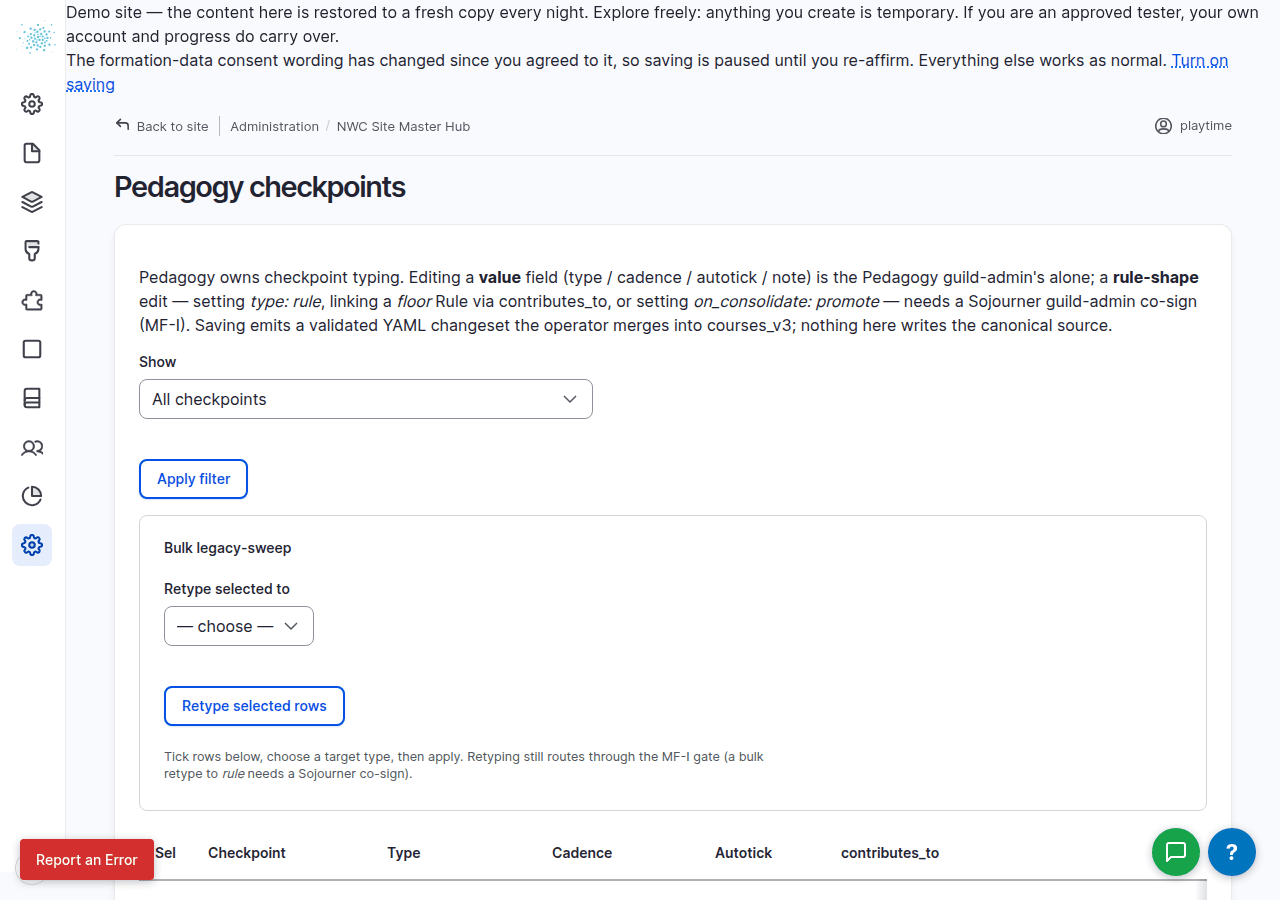
| Checkpoint | The application, typed — a task to do once, a habit to repeat, a skill to practise — so the app can hold you to it. |
| Quiz | A handful of questions per learning point, each with a difficulty and feedback on every option. |
| References | Catechism paragraphs, dogmatic propositions and related learning points — the idea’s roots and neighbours. |
The six depths
One explanation, six lengths. The reader chooses; the teaching stays the same.
| Depth | |
|---|---|
short | A summary. One breath. |
standard | The plain teaching, complete but brief. |
longer | The same teaching with more room. |
detailed | Fuller reasoning and references. |
advanced | For readers who want the argument. |
scholar | Sources and scholarship. Rarely filled in yet. |
Honest status: Scholar is rarely filled in yet. Measured on 2026-08-02 across the canonical catalogue, it carried content on 0 of 251 learning points. The renderer declares all six tiers and greys out any tier with nothing written, so a greyed Scholar button is the level being unwritten — not a defect to report. The other five are written.
Application and checkpoints
An application says what to do. A checkpoint says what kind of doing it is, which is what lets the app pace it. Five types exist; the counts are from the whole catalogue.
| Type | Meaning | In the catalogue |
|---|---|---|
task | Do this once. | 96 |
challenge | A stretch, once. | 6 |
habit | Repeat it — daily, weekly, monthly. | 11 |
skill | Practise until it is yours. | 5 |
suggested | Offered, not required. | 21 |
More depth — framing atoms, and what is designed but not yet written
The schema allows a learning point to carry framing atoms beside its core explanation: an intro, an example, a metaphor, a story, a contrast (a non-example that shows where the idea stops). Each atom is tagged with an audience — youth, single, married, religious, priest — and a depth, so the same idea can be framed differently for different readers without the core changing.
Honest status: as of 2026-09-06 the catalogue holds no framing atoms and no contrasts. They are designed, the guilds that own them exist, and the editing surfaces on this site are where they will be proposed — but a reader today sees the core explanation, the application, the checkpoint and the quiz.
Technical — the schema fields
Canonical store: the v3 catalogue, YAML per course, contracted by schema v3.1. A course file is course: { code, title, category, paradigm, tier, prerequisites, sessions, learning_points[] }. Each learning point: id, title, session, depths{short…scholar}, core, contrast[], variants[], contributed[], application[], checkpoints[], quiz_items[], practice{action, habit_tip}, related_points[], catechism_paragraphs[], dogmatic_propositions[]. An atom is { slot, audience, depth, body, breaks_down_at, prompt_self } with slot one of intro, example, metaphor, contrast, application, story. A checkpoint is { key, type, title, autotick, pacing, cadence, pedagogy_note, contributes_to, on_consolidate, adopts_as }. Render targets — Moodle mod_depthcontent, the offline app, this site — are pure functions of the built JSON and are disposable.
Catalogue figures on these pages were measured on 2026-09-06 — 56 courses, 251 learning points — and are not read live; they can go stale, and say so.